When self-service works, it feels effortless. When self-service fails, it can turn a simple task into a stressful one – especially when customers are tired, rushed and just want things to be easy. That is why human support still matters in customer experience, even in the most ‘efficient’ environments.
Last week, during a late-night supermarket shop with a trolley piled high for a full-house family weekend, I was reminded that CX is not shaped by policies or spreadsheets – it is shaped in the small, high-pressure moments when something goes wrong and someone steps in to help.
Imagine the scene: It’s Friday night, you’ve had a long week – you’re already tired but you’re shopping because you have people coming to stay over the weekend.
In our case it was family. Full house. Our 3 boys, their partners and their 4 sons, our grandsons. Full fridge required, so there I was. Big trolley. Stacked high. Milk. Bread. Fruit. Veg. Snacks for the grandsons. Things that come in jars. Things that come in packets. Every brand of drink you can think of. Extra toiletries, nappies, wipes – just in case. Every little luxury you keep for occasions like this – chocolate, ice cream, sweets – you know what I mean.
I got to the tills, after almost 2 hours of filling my trolley to the brim. And every single staffed till was closed. Every single one. Only self-serve tills open. A sea of glowing screens. A small crowd of weary humans. All scanning. All sighing. All waiting for the little green light that says the machine has accepted their existence.
I joined the queue – I had no choice.
I watched people with two items sail through. I watched people with twenty items get stuck. I watched one poor soul trying to buy bananas and a birthday card while the machine insisted they were attempting a heist. Then it was my turn. I started scanning. Beep… Beep… Beep…
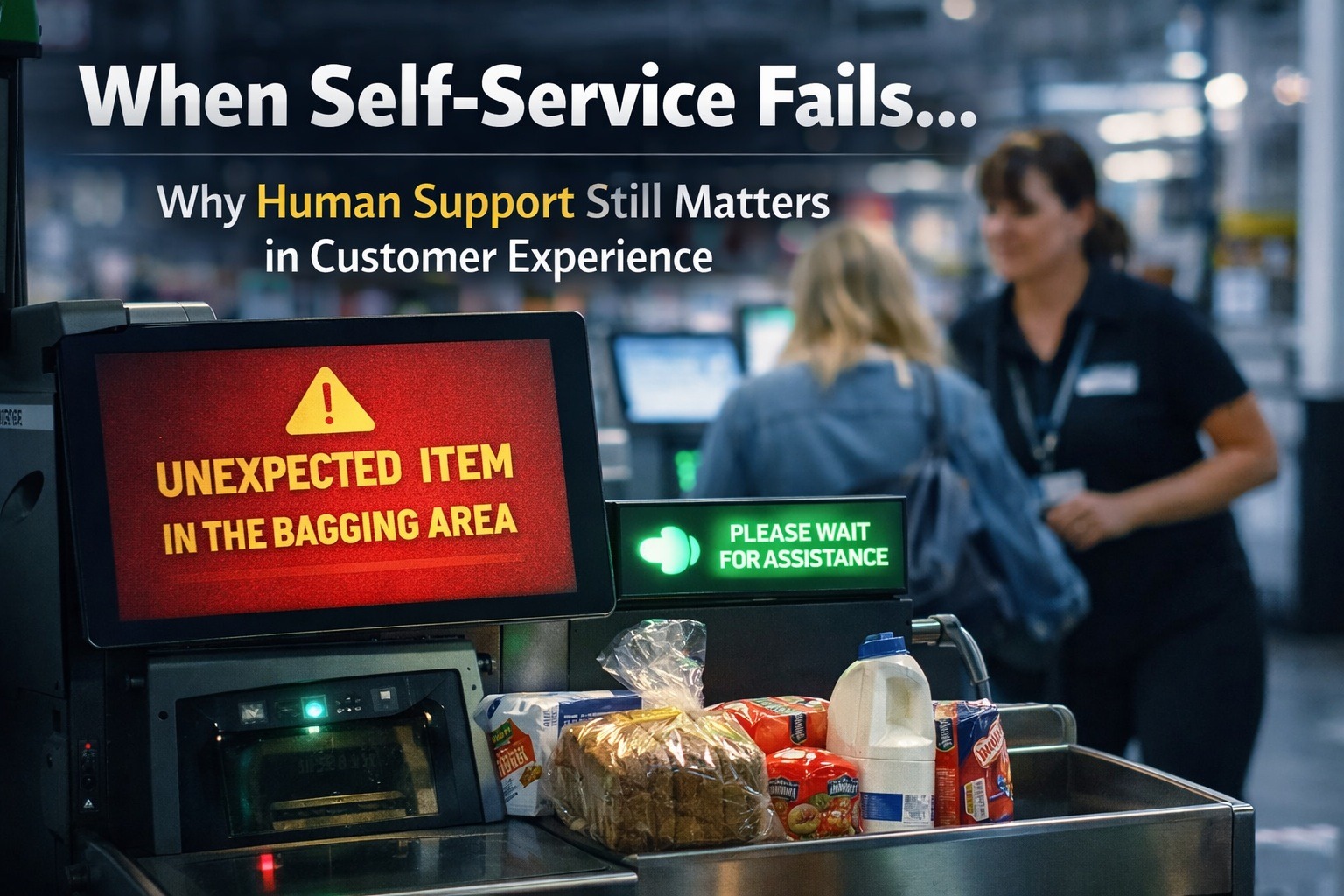
So far so good…. and then it happened. Unexpected item in the bagging area. The words that can ruin an entire shopping experience (as if it’s not hell already!)
I froze. Because you don’t want to make the situation worse. So you stand still. Hands off. Like you are negotiating with a wild animal.
The machine shouted again. Unexpected item in the bagging area. I looked around for help. One member of staff – just ONE! Trying to support 6 self-serve tills. She was already mid-rescue at the far end, helping someone who’d scanned alcohol. Someone else had scanned something twice. Someone else had pressed the wrong button.
So I waited…and the queue behind me built.
I could feel the heat of impatience. Not anger – not yet at least, although it was heading that way. The staff member arrived. She smiled. She did not look frazzled. She did not roll her eyes. She simply said, “It’s OK. This happens all the time. Let’s get you sorted.” That sentence changed the whole temperature.
“It’s OK. This happens all the time. Let’s get you sorted”. 3 simple lines.
She tapped her code. She moved one item slightly and the machine calmed down. So I carried on. Then it happened again. Unexpected item in the bagging area. She returned. Same tone. Same calm voice. Same energy. No drama. No blame. No sigh.
Just service.
I drove home thinking about that moment. Not the self-serve. Not the decision to close staffed tills or the rubbish technology. The moment. The human moment. Because customers do not experience your organisation in spreadsheets or staff schedules. They experience it in moments like that. When they are tired. When they are rushed. When the trolley is full. When the pressure is high. When they want it to be easy. And it’s not.
It got me thinking about business. Because many companies remove human help in the name of efficiency.
Sometimes that’s sensible. Sometimes it’s necessary. However, understand there is a hidden cost. When you shift effort onto the customer at the hardest point, you also shift emotion. You transfer stress. You transfer frustration. You transfer the feeling of “Why is this so difficult?” And if there is not a human there to steady it, the stress grows teeth. It shows up as frustration. It shows up as ambivalence. It shows up as a complaint.
So what do we do?
We design service around the hardest moments, rather than the easiest ones! So, that’s today’s FIT tip:
Reduce customer effort where it hurts.
Pick one point in your customer journey where people are most likely to be tired, rushed or worried.
Billing queries. Delivery delays. Cancellations. Complaints. Technical issues.
Then ask a simple question.
Where are we making the customer do work that we could do for them?
Then fix one tiny thing. One extra line of reassurance. One clearer next step. One proactive update. One human voice at the right time. Maybe one extra pair of hands during peak pressure.
So, try walking your customer journey with a ‘tired customer’ mindset this week.
Where would you sigh? Where would you feel stuck? Where would you feel judged? Or invisible?
Find one friction point. Remove one stone from the shoe.
It doesn’t need a budget. It needs attention.
Because when the moment is hard the smallest kindness feels huge.
Until next time – take care and keep FIT💪
Best regs,
Marie